Argentine ants (Linepithema humile) present a severe structural challenge across Los Angeles County due to their continuous supercolony structure. Unlike native territorial ant species, separate nests of Argentine ants…
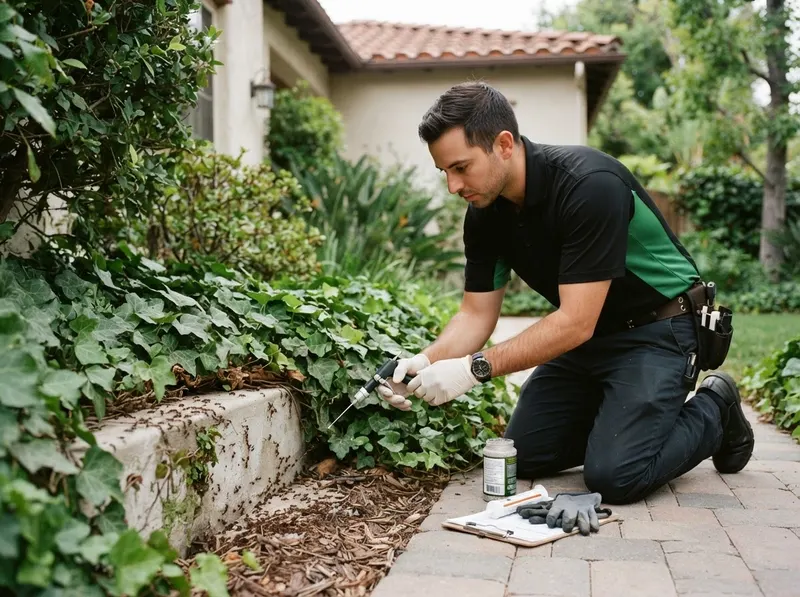
Argentine ants (Linepithema humile) present a severe structural challenge across Los Angeles County due to their continuous supercolony structure. Unlike native territorial ant species, separate nests of Argentine ants do not fight one another; instead, multiple queens and satellite colonies cooperate across vast territories. Standard off-the-shelf pyrethroid sprays trigger an immediate defense reflex known as colony budding: worker mortality causes surviving sub-colonies to fracture, disperse deeper into subflooring or wall voids, and accelerate egg production under multiple surviving queens. Nexora Pest Defense approaches this threat through systematic non-repellent transfer chemistry. Non-repellent active ingredients remain undetected by foraging workers, allowing ants to walk through treated micro-zones, coat their cuticles, and consume the liquid food matrices without immediate toxic shock.
The horizontal transfer process relies on trophallaxis, the biological exchange of regurgitated food among nest members. Foraging workers transport the non-repellent active ingredient deep beneath structural foundations, patios, and root systems, directly dosing the reproductive queens and brood that never leave the inner chambers. If an infestation is localized to surface pavement cracks, targeted perimeter micro-dosing controls the ingress; if subterranean supercolonies encompass extensive root networks beneath mature landscaping, broadcast perimeter saturation combined with sub-slab injection creates an unbroken zone of biological transfer. The primary trade-off involves time: fast-acting contact sprays provide immediate knockdown of visible trail workers within 10 minutes but leave queens unharmed, while colony transfer treatments require 10 to 18 days of visible foraging activity to achieve 100% queen mortality and prevent structural re-infestation.
Microclimatic conditions across Los Angeles dictate treatment vectors. During dry Santa Ana wind events, low ambient moisture drives massive subterranean foraging columns out of arid outdoor zones into residential kitchens and plumbing chases. In the damp coastal soil of Venice and Pacific Palisades, nests concentrate along moist sand-soil interfaces, irrigation valve boxes, and foundation footings. In sloped hillside terrain like Silver Lake, Los Feliz, and Echo Park, expansive root networks of eucalyptus and ficus trees serve as subterranean highways connecting exterior colonies directly to crawlspaces. Inland Valley properties in Sherman Oaks and North Hollywood encounter rapid population surges during summer heatwaves exceeding 95 degrees, while dense urban structural footprints in Koreatown and Boyle Heights feature continuous concrete slabs that conceal extensive underground nesting systems. Nexora Pest Defense pairs chemical transfer protocols with physical perimeter sealing to deny re-entry across all architectural foundation types.
Every job gets a firm, written price after a free on-site visit.
Tell us about your argentine ant colony transfer treatments job in Los Angeles and we'll send a clear, written quote, usually the same day.
 Nexora Pest Defense